
Saturday, June 30, 2012


9 Beliefs of Remarkably Successful People
I'm fortunate enough to know a number of remarkably successful people. Regardless of industry or profession, they all share the same perspectives and beliefs.
And they act on those beliefs:
1. Time doesn't fill me. I fill time.
Deadlines and time frames establish parameters, but typically not in a good way. The average person who is given two weeks to complete a task will instinctively adjust his effort so it actually takes two weeks. Forget deadlines, at least as a way to manage your activity. Tasks should only take as long as they need to take. Do everything as quickly and effectively as you can. Then use your "free" time to get other things done just as quickly and effectively. Average people allow time to impose its will on them; remarkable people impose their will on their time.
2. The people around me are the people I chose.
Some of your employees drive you nuts. Some of your customers are obnoxious. Some of your friends are selfish, all-about-me jerks. You chose them. If the people around you make you unhappy it's not their fault. It's your fault. They're in your professional or personal life because you drew them to you--and you let them remain. Think about the type of people you want to work with. Think about the types of customers you would enjoy serving. Think about the friends you want to have. Then change what you do so you can start attracting those people. Hardworking people want to work with hardworking people. Kind people like to associate with kind people.
Successful people are naturally drawn to successful people.
3. I have never paid my dues.
Dues aren't paid, past tense. Dues get paid, each and every day. The only real measure of your value is the tangible contribution you make on a daily basis. No matter what you've done or accomplished in the past, you're never too good to roll up your sleeves, get dirty, and do the grunt work. No job is ever too menial, no task ever too unskilled or boring. Remarkably successful people never feel entitled--except to the fruits of their labor.
4. Experience is irrelevant. Accomplishments are everything.
You have "10 years in the Web design business." Whoopee. I don't care how long you've been doing what you do. Years of service indicate nothing; you could be the worst 10-year programmer in the world. I care about what you've done: how many sites you've created, how many back-end systems you've installed, how many customer-specific applications you've developed (and what kind)... all that matters is what you've done. Successful people don't need to describe themselves using hyperbolic adjectives like passionate, innovative, driven, etc. Remarkably successful people don't need to use any adjectives at all. They can just describe, hopefully in a humble way, what they've done.
5. Failure is something I accomplish; it doesn't just happen to me.
Ask people why they have been successful. Their answers will be filled with personal pronouns: I, me, and the sometimes too occasional we. Ask them why they failed. Most will revert to childhood and instinctively distance themselves, like the kid who says, "My toy got broken..." instead of, "I broke my toy." They'll say the economy tanked. They'll say the market wasn't ready. They'll say their suppliers couldn't keep up. They'll say it was someone or something else. And by distancing themselves, they don't learn from their failures. Occasionally something completely outside your control will cause you to fail. Most of the time, though, it's you. And that's okay. Every successful person has failed. Numerous times. Most of them have failed a lot more often than you. That's why they're successful now.
Embrace every failure: Own it, learn from it, and take full responsibility for making sure that next time, things will turn out differently.
6. Volunteers always win.
Whenever you raise your hand you wind up being asked to do more. That's great. Doing more is an opportunity: to learn, to impress, to gain skills, to build new relationships--to do something more than you would otherwise been able to do. Success is based on action. The more you volunteer, the more you get to act. Successful people step forward to create opportunities. Remarkably successful people sprint forward.
7. As long as I'm paid well, it's all good.
Specialization is good. Focus is good. Finding a niche is good.
Generating revenue is great. Anything a customer will pay you a reasonable price to do--as long as it isn't unethical, immoral, or illegal--is something you should do. Your customers want you to deliver outside your normal territory? If they'll pay you for it, fine. They want you to add services you don't normally include? If they'll pay you for it, fine. The customer wants you to perform some relatively manual labor and you're a high-tech shop? Shut up, roll 'em up, do the work, and get paid. Only do what you want to do and you might build an okay business. Be willing to do what customers want you to do and you can build a successful business. Be willing to do even more and you can build a remarkable business. And speaking of customers...
8. People who pay me always have the right to tell me what to do.
Get over your cocky, pretentious, I-must-be-free-to-express-my-individuality self. Be that way on your own time. The people who pay you, whether customers or employers, earn the right to dictate what you do and how you do it--sometimes down to the last detail. Instead of complaining, work to align what you like to do with what the people who pay you want you to do. Then you turn issues like control and micro-management into non-issues.
9. The extra mile is a vast, unpopulated wasteland.
Everyone says they go the extra mile. Almost no actually one does. Most people who go there think, "Wait... no one else is here... why am I doing this?" and leave, never to return.
That's why the extra mile is such a lonely place. That's also why the extra mile is a place filled with opportunities. Be early. Stay late. Make the extra phone call. Send the extra email. Do the extra research. Help a customer unload or unpack a shipment. Don't wait to be asked; offer. Don't just tell employees what to do--show them what to do and work beside them. Every time you do something, think of one extra thing you can do--especially if other people aren't doing that one thing. Sure, it's hard. But that's what will make you different.
And over time, that's what will make you incredibly successful.
Thursday, June 28, 2012
Recruiters: Brick Walls or “Holders of the Secrets”?
Recruiters appear to be at the top of most jobseekers’ hit lists. Most people I have come across are certainly soured by the recruiter/jobseeker relationship, united in their criticisms that search consultants are the impenetrable brick wall to job search success; the self-serving, commission-focused obstructionist front line preventing a love match between the candidate and the employer.
Recruiters are human, so naturally there will be people who try to take the line of least resistance, be burned out or dismissive of your emotions. For those few who give the industry a bad name, there are many who fly the flag of excellence. Those people can be your greatest advocate as “Holder of the Secrets”.
Did you know that the search consultant can run interference for you on salary, benefits and perks? Search Consultants know what the employer wants, are savvy to the lengths the employer is willing to pay, understand the classifications and pay scales the firm follows, and evaluates the potential for negotiations. After advising you, the recruiter is able to test that flexibility without your involvement, leaving you squeaky clean, talented and willing to start work when everything has been ironed out. Recruiters are used to negotiations; it is part of the business and is expected by the employer. No emotions involved, no bad feelings. Allow them to apply their knowledge to your benefit.
As “Holder of the Secrets” the search consultant has been fully briefed on the required experience and industry background the employer demands. Consequently, if the recruiter suggests to you that your resume should include more information about your time at BHP in 1986 because the employer wants the candidate to have mining and exploration experience, then do it! Regardless of how silly it sounds or how it goes against everything you know about resumes, just do it! As “Holder of the Secrets” the recruiter is leaving crucial signposts to help you on your journey. It is up to you to heed this advice and recognise these pointers as “secrets” other candidates may not have or be privy to.
Search consultants have a stake in your successful placement and it is not limited to one commission payment. Experienced recruiters are astute enough to recognise that such relationships are a two-way street; after he helps you, you may choose him to help you hire your team. A kind of “you pat my back, I’ll pat yours” arrangement.
So the next time you deal with a recruiter, given him or her a chance to rise to your expectations before you dismiss them as that sturdy brick wall. You may find that your courtesy, flexibility and willingness to listen will do more for your candidacy and positioning for roles now and in the future, than herding them all under the heading of “necessary evil”.
The biggest mistake on a resume (and how to create a masterpiece)
There are about five or six common mistakes that people make when preparing their resumes, and most of these stem from the one Biggest Mistake. And this is what prevents you from creating the masterpiece that lands you the job.
Once upon a time (maybe) it seemed that we could just write a resume, or get a friend who's a better writer than us write our resume. You could polish the intro statement into a work of art. Craft each job description so finely that they were as short as possible while still conveying your work history in eloquent prose.
Then, having finished this masterpiece, you were armed with the perfect document to wow employers across the spectrum of roles that interested you and land your dream job.
I'm not sure if this was ever true, but it certainly isn't now. That finely-tuned resume should actually serve only as a template for the ones you actually send out.
The biggest mistake on a resume? Using the same one over and over again. Employers can spot a generic application in a nanosecond, and they don't like it. Hiring managers want to see a document that tailors your skills and experience specifically to the job they posted, and demonstrates what you can do for them.
Five other resume mistakes (that generally stem from the Biggest Mistake on a Resume):
1 - Not matching your title to the job
The title of your resume should match the title of the job you are applying to. If your resume has a different title, it looks like you are applying to a different job. Don't make the hiring manager try to guess how your particular career title matches up with the position they are hiring for. Make it clear. If you're applying for the Office Manager position, send in a resume with 'Office Manager' in the title.
2- Describing job responsibilities - not accomplishments
Hiring managers know what job descriptions match your old job titles. There's little mystery in what an Editor or a Customer Service Representative does. The unique and interesting part is what you alone accomplished in that role. What set you apart? What have you done, learned or accomplished there that can be particularly useful to your potential new employer. Use numbers if you can.
3- Not tailoring your work history and accomplishments
All of your jobs, community or voluntary work can potentially be relevant if you can highlight how the skills you learned and used benefit your new employer. You have to market your transferable skills to the target company's business needs. (You'll know what these are from carefully reading the job description that you are applying to.) Sell your experience.
4- Listing too many jobs
As much as I said that every job and community activity can be relevant, it is also possible to list too many on a resume. I don't believe that a resume has to fit on one page, or even on two if you need more space to sell your story. However, everything that is included has to be compelling. Descriptions of irrelevant jobs that you held a decade or more ago will only serve to take up valuable space and water down the good stuff. Keep it recent, and cut to the essentials.
If you have valuable accomplishments from many older jobs that you think it is important to include, consider using an 'Other Relevant Experience' sub section underneath your recent work history where you can bullet point these wins briefly.
5- Not proofreading
Need I say it? Employers expect you to try hard, pay attention to detail and produce quality work on the job.
What does it say to an employer about a candidate who can't even present an error-free document when they are most trying to impress them in order to land the job in the first place? That you're either not that good, or that you don't care that much. Either way, you won't be getting the call for an interview.
Proofread. Take a break. Proofread again. Then have someone else proofread it for you.
The real 'masterpiece' resume is the one that speaks to an employer so much that it is as though it were written just for them personally. And that's because it has been.
Wednesday, June 27, 2012
The 7 Habits of Highly Innovative People
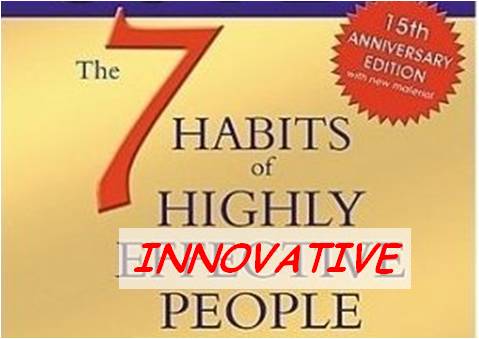
Habit 1: Be Passionate. Finding your passion is not only the key to happiness, but also the key to business success. As Steve Jobs once said, “Your time is limited, so don’t waste it living someone else’s life. The only way to do great work is to love what you do. If you haven’t found it yet, keep looking. Don’t settle.” (Be Proactive)
Habit 2: Do Something. You don’t always know where it’s going to lead, but it’s always better to do something than to suffer analysis paralysis. Legendary oil-man and entrepreneur T. Boone Pickens has a way of quickly sizing up a situation, coming up with a plan, and acting. There’s no sitting around or endless analysis and debate. It seems to have worked for him. (Begin with the End in Mind)
Habit 3: Put First Things First, Second, and Third. Covey says prioritize, but I’ll take it one step further. Whoever said, “don’t sweat the small stuff,” was right, and I’ll add, “don’t do or even think about the small stuff.” Every successful innovative person I know jumps on hot opportunities and critical issues like they’re the only things that matter on god’s green Earth. (Put First Things First)
Habit 4: Think Win. Former New York Yankees owner George Steinbrenner may have been a world-class a-hole, but he was a remarkably rich and successful world-class a-hole who let nothing stand in the way of the only thing that ever really mattered to him, winning. Bill Gates, Larry Ellison – show me a successful entrepreneur and I’ll show you someone who puts winning first. (Think Win/Win)
Habit 5: Seek First to Understand, then to Innovate. The key to innovation is to first understand a big hairy problem that, to date, nobody’s been able to solve. Once you’ve got that, then, and only then, does it even begin to make sense to do something about it. Otherwise you’ll just end up with a great product nobody needs. (Seek First to Understand, then to be Understood)
Habit 6: Energize. With rare exception, successful innovators are high-energy people with a unique ability to stimulate and motivate others. That’s called leadership. Without it, you can have the most effective habits or the best ideas in the world, but nobody will ever know it, because nobody will care and nothing will actually get done. (Synergize)
Habit 7: Question the Status Quo. Andy Grove built semiconductor powerhouse Intel on several principles, two of which were “only the paranoid survive” and “constructive confrontation.” That means never rest on your laurels, continually challenge your own assumptions, and always question the status quo. That’s how Intel became a high-tech dynasty. (Sharpening the Saw)
Friday, June 22, 2012
Gloom and doom back in style
Weak economic data from the US and China has encouraged selling of stocks and commodities over the last 24 hours. Americans’ claims for unemployment benefits remained at essentially the same level as last month, while a Philly Fed regional manufacturing survey showed yet another contraction. Brent crude futures fell 3.7% to settle at $89.23 a barrel – their lowest close since December 2010, while WTI lost 4% on the day to settle at $78.20, the lowest since October. Coming just a day after the Fed disappointed investors with its “no QE3 yet” message, it’s little surprise that we’re seeing the same old dash to the US dollar and Treasuries, as deflation expectations rise. The Dollar Index (USDX) is back above 82.00, while the yield on the 10-Year Treasury Note has fallen to 1.62%.

Precious metals are under pressure again, with gold falling towards $1,550 and silver breaking below $27. We saw strong buying support show up for gold last month when it fell below $1,550 courtesy of Asian central banks, so bulls will have to hope the same buyers come to the rescue. Likewise, silver tested the $26 mark at the end of last year, but encountered strong buying support that sent the metal on a $10 rally to $36 by the end of February. $26 is critical support.
Moody’s added to the gloom after the US close by downgrading the long-term credit ratings of 15 major North American and European banks. This will force these banks to post extra collateral against trades, and adds to the bearish pressure on stocks, commodities, and the bonds of many euro-zone governments
5 Ways to Maintain Your Value on the Job Market
1. Do not bounce from job to job
As a job seeker, be aware that an inverse relationship exists between the number of jobs you have had in the past few years and the likely amount of your next job offer. Bouncing from job to job is a serious red flag to employers….
This is regardless of whether the job hopping is a true representation of your professional reliability. Although it looks better if you left the jobs rather than if you got fired, either is still a clear negative on your CV.
The best advice I can give to those who have had a few jobs in the past few years is to be upfront about the issue on either your resume (in the objective section) or within your cover letter.
Remember to be candid, clearly state that you want a job within an organization that you can grow with for the years to come and do not make excessive excuses for your failure to be at each company for longer time periods.
2. Continue to hit quotas or receiving professional awards
This is much easier said than done as there are many uncontrollable variables for the job seeker when it comes to this arena. To maintain hitting your quotas as a sales professional, come to an agreement with your current employers as to what fair numbers are...though, do it after being at the company for a little bit.
You'd be surprised as to how firms are willing to negotiate this aspect of your sales job and how lucrative meeting those numbers will prove to be at future jobs.
3. Do not have gaps in your resume
Although logic would say that someone unemployed for an extended period of time is much more eager to get back to work than somebody who has had 10 jobs in the past 12 years, 'tis is not the case. We all want what others have and prolonged unemployment on one's resume turns employers off.
As a job seeker who has been unemployed for a period of time, what do you do to fill any gap of unemployment?
I recommend doing some sort of charity work if you can't find the job right for you. Not only will this show the employer that you have been active, but the charity may hit home in the HR rep's heart and you can slide in for an easy interview.
4. Leave jobs on a positive note
Regardless of how much of a pain your boss is, always do your best to leave your current company with a smile on your face and remain in good terms with the individuals at your now prior firm.
Remember that those who are smart enough not to get the last word in, are less likely to receive a bad recommendation killing a lucrative job offer last minute. When angry, people can be irrational, vindictive and immature; don't give your now ex-manager reason to act in manners as such.
5. Try to stay in no more than 2 or 3 industries
In any industry, to get over a certain point in salary range, you must be considered an expert in your respective field. The more niche this field is, the more lucrative your future job offers are going to be.
For instance, being in media is not likely to warrant as high as job offer as someone who has the same amount of years in something more specific such as social media.
After 2 or 3 jobs, you should find an industry that you truly love and shine in it. Not only will this increase future compensation, but it will also increase your career longevity as well as the contacts you make within the vertical and the ability to continuously leverage those relationships.
Additionally, if you're ever looking to relocate, your chances will be higher possessing a niche expertise.
US July visa bulletin – Apply for EB-2 visa application by 29 June!
If you have an US EB-2 employment based petition with a priority date later than 1 January 2009 and are not from China or India then you should file your adjustment of status visa application or consular processing visa application by Friday 29 June 2012. The US Department of State (DOS) has just released the July 2012 visa bulletin stating that from 1 July 2012 the employment-based EB-2 immigrant visa priority cutoff date will move back to January 1, 2009 for all countries except India and China. The situation for people from India and China is even worse. The EB-2 priority cutoff dates for India and China are unavailable for the current fiscal year meaning no new visas will be issued to EB-2 applicants from India or China until after fiscal year 2013 begins on October 1, 2012.
However, even when visas become available for applicants from China and India in the next fiscal year, the cutoff date will be different than for other countries. It is likely that only Chinese and Indian applicants who have a priority date from many years ago will be able to have their visas processed.
What is a priority cutoff date?
Employment based immigration priority cutoff dates determine when a foreign national will be able to file their Adjustment of Status (AOS) applications or application at the US Embassy or Consulate and apply for their green card. The priority date refers to the date an application is initially filed in the green card process; For employment based petitions this is when the labor certification application is filed or in some limited cases when the immigration preference petition I-140 is filed. The US will begin processing a green card application if your priority date is earlier than the cutoff date listed in the most recent Visa Bulletin.The DOS publishes a monthly visa bulletin that lists the cutoff dates for different immigration categories and countries. Only immigrants with priority dates before the cutoff date are permitted to file their visa applications and apply for their green card.
Therefore, applicants from countries other than India and China, who have a priority cutoff date of January 01, 2009 or later, will need to file for AOS or visa processing at an Embassy or Consulate before June 30, 2012. This is because the July 2012 visa bulletin goes into effect July 1, 2012. If you do not apply before then, you will have to wait for a suitable cut off date before you can file your visa application; This is a cut off date after your priority date.
The EB-2 visa is available to applicants who have an advanced degree or its equivalent with an approved PERM labor certification, or a foreign national who has exceptional ability. Additionally, foreign workers who can show that their activities will substantially benefit the US national interest may be eligible for the EB-2 visa.
Priority cutoff dates for other countries
While for the EB-3 category the cutoff dates for professionals and skilled workers did advance, it may still take many years for your application to be processed. You will see below that the latest cut off date is about six years ago.The EB-3 visa is an employment-based visa with three categories available:
- Skilled workers: people whose job requires a minimum of 2 years training or work experience, not of a temporary or seasonal nature
- Professionals: people whose job requires at least a US baccalaureate degree or a foreign equivalent and are a member of the professions
- Other workers: people performing unskilled labor requiring less than 2 years training or: experience, not of a temporary or seasonal nature.
- China's date advanced from August 08, 2005 to September 22, 2005
- India's date advanced from September 15, 2002 to September 22, 2002
- The Philippines date advanced from May 22, 2006 to June 8, 2006
- All other countries dates advanced from June 8, 2006 to July 22, 2006
- China's date advanced from April 22, 2003 to June 15, 2003
- India's date advanced from September 15, 2002 to September 22, 2002
- The Philippines date advanced from May 22, 2006 to June 8, 2006
- All other countries dates advanced from June 8, 2006 to July 22, 2006
Wednesday, June 20, 2012
Making Yourself Indispensable in the Workplace
Warning: this article contains a lot of ways to suck up to management. These kind of tips won’t help your chances of curing cancer, but they might help you get a little extra boost in your career.
There are a host of reasons you may have for wanting to impress your boss (a promotion or raise, a glowing reference, work perks), but the question of the day is whether or not putting in extra hours, bringing work home, and taking on more responsibilities is worth the value of making your boss think that you are a shining star among mere light bulbs. While effort is obviously required in order to be a stand-out employee, there are a number of ways to become an indispensable workplace presence without spreading yourself too thin.
1. More likely than not your boss is big on punctuality and consistently arrives at work on time. You can easily show your dedication to your job by always arriving at work and being prepared to begin your day by your official start time. Make a note of when your boss typically arrives at work and shoot for showing up about five minutes ahead of his or her regular time. And no matter how sleep-deprived and grumpy you may feel, slap a smile on your face and politely greet your boss every morning.
2. Though your workload may already be jam-packed you should seriously considering being among the first to volunteer for select, high-visibility projects that can help shape your bosses perception of your into one where you are seen as an eager person willing to branch out and take on responsibilities beyond your required duties. This also gives you some amount of control over any additional work you must complete by not simply taking what you boss assigns but speaking up and taking the tasks you want.
3. Everyone office has a “go-to guy;” that person who everyone turns to when toner is low, software stalls, papers get jammed, or incomprehensible error messages appear on fax machines. Even if it has nothing to do wither your regular job, make a small effort to learn the tech side of how the office runs. You know – learn where paper, ink, and toner are kept and how to properly install them into your office printer. Know how to use that million dollar software system that no one else does. And when you encounter an inevitable tech problem, take the time to learn the solution instead of simply ignoring the situation until a techie solves the problem. Tech know-how can be seen as life-saving: especially to a boss who has a printer gremlin show up before a big meeting.
4. This act will make you popular throughout your office, not just with your boss. Make the office coffee and, every once in a while, remark to your boss that you’re making it and ask if he or she would like a cup. Don’t become the person who run errands, but showing up with donuts once in a while never hurt anyone’s career. Be the person who brings life to the office and is fun and positive to be around. Unexpected small actions are fun and keep work life interesting.
5. Listen to your boss’s word choices when discussing business concerns and note any buzzwords that are used frequently. Assimilate them into your own vocabulary and use them in meetings and emails. This smart use of language helps to show your boss that you genuinely understand what he or she is after.
Working hard and performing well will always be the best method for success, but in order to reinforce positive perceptions and get the attention your deserve, these career tips offer a way to insert yourself into your boss’s routine without being overbearing or annoying.
Sunday, June 17, 2012
Caring for Your Introvert
The habits and needs of a little-understood group
Do you know someone who needs hours alone every day? Who loves quiet conversations about feelings or ideas, and can give a dynamite presentation to a big audience, but seems awkward in groups and maladroit at small talk? Who has to be dragged to parties and then needs the rest of the day to recuperate? Who growls or scowls or grunts or winces when accosted with pleasantries by people who are just trying to be nice?
If so, do you tell this person he is "too serious," or ask if he is okay? Regard him as aloof, arrogant, rude? Redouble your efforts to draw him out?
If you answered yes to these questions, chances are that you have an introvert on your hands—and that you aren't caring for him properly. Science has learned a good deal in recent years about the habits and requirements of introverts. It has even learned, by means of brain scans, that introverts process information differently from other people (I am not making this up). If you are behind the curve on this important matter, be reassured that you are not alone. Introverts may be common, but they are also among the most misunderstood and aggrieved groups in America, possibly the world.
I know. My name is Jonathan, and I am an introvert.
Oh, for years I denied it. After all, I have good social skills. I am not morose or misanthropic. Usually. I am far from shy. I love long conversations that explore intimate thoughts or passionate interests. But at last I have self-identified and come out to my friends and colleagues. In doing so, I have found myself liberated from any number of damaging misconceptions and stereotypes. Now I am here to tell you what you need to know in order to respond sensitively and supportively to your own introverted family members, friends, and colleagues. Remember, someone you know, respect, and interact with every day is an introvert, and you are probably driving this person nuts. It pays to learn the warning signs.
What is introversion? In its modern sense, the concept goes back to the 1920s and the psychologist Carl Jung. Today it is a mainstay of personality tests, including the widely used Myers-Briggs Type Indicator. Introverts are not necessarily shy. Shy people are anxious or frightened or self-excoriating in social settings; introverts generally are not. Introverts are also not misanthropic, though some of us do go along with Sartre as far as to say "Hell is other people at breakfast." Rather, introverts are people who find other people tiring.
Extroverts are energized by people, and wilt or fade when alone. They often seem bored by themselves, in both senses of the expression. Leave an extrovert alone for two minutes and he will reach for his cell phone. In contrast, after an hour or two of being socially "on," we introverts need to turn off and recharge. My own formula is roughly two hours alone for every hour of socializing. This isn't antisocial. It isn't a sign of depression. It does not call for medication. For introverts, to be alone with our thoughts is as restorative as sleeping, as nourishing as eating. Our motto: "I'm okay, you're okay—in small doses."
How many people are introverts? I performed exhaustive research on this question, in the form of a quick Google search. The answer: About 25 percent. Or: Just under half. Or—my favorite—"a minority in the regular population but a majority in the gifted population."
Are introverts misunderstood? Wildly. That, it appears, is our lot in life. "It is very difficult for an extrovert to understand an introvert," write the education experts Jill D. Burruss and Lisa Kaenzig. (They are also the source of the quotation in the previous paragraph.) Extroverts are easy for introverts to understand, because extroverts spend so much of their time working out who they are in voluble, and frequently inescapable, interaction with other people. They are as inscrutable as puppy dogs. But the street does not run both ways. Extroverts have little or no grasp of introversion. They assume that company, especially their own, is always welcome. They cannot imagine why someone would need to be alone; indeed, they often take umbrage at the suggestion. As often as I have tried to explain the matter to extroverts, I have never sensed that any of them really understood. They listen for a moment and then go back to barking and yipping.
Are introverts oppressed? I would have to say so. For one thing, extroverts are overrepresented in politics, a profession in which only the garrulous are really comfortable. Look at George W. Bush. Look at Bill Clinton. They seem to come fully to life only around other people. To think of the few introverts who did rise to the top in politics—Calvin Coolidge, Richard Nixon—is merely to drive home the point. With the possible exception of Ronald Reagan, whose fabled aloofness and privateness were probably signs of a deep introverted streak (many actors, I've read, are introverts, and many introverts, when socializing, feel like actors), introverts are not considered "naturals" in politics.
Extroverts therefore dominate public life. This is a pity. If we introverts ran the world, it would no doubt be a calmer, saner, more peaceful sort of place. As Coolidge is supposed to have said, "Don't you know that four fifths of all our troubles in this life would disappear if we would just sit down and keep still?" (He is also supposed to have said, "If you don't say anything, you won't be called on to repeat it." The only thing a true introvert dislikes more than talking about himself is repeating himself.)
With their endless appetite for talk and attention, extroverts also dominate social life, so they tend to set expectations. In our extrovertist society, being outgoing is considered normal and therefore desirable, a mark of happiness, confidence, leadership. Extroverts are seen as bighearted, vibrant, warm, empathic. "People person" is a compliment. Introverts are described with words like "guarded," "loner," "reserved," "taciturn," "self-contained," "private"—narrow, ungenerous words, words that suggest emotional parsimony and smallness of personality. Female introverts, I suspect, must suffer especially. In certain circles, particularly in the Midwest, a man can still sometimes get away with being what they used to call a strong and silent type; introverted women, lacking that alternative, are even more likely than men to be perceived as timid, withdrawn, haughty.
Are introverts arrogant? Hardly. I suppose this common misconception has to do with our being more intelligent, more reflective, more independent, more level-headed, more refined, and more sensitive than extroverts. Also, it is probably due to our lack of small talk, a lack that extroverts often mistake for disdain. We tend to think before talking, whereas extroverts tend to think by talking, which is why their meetings never last less than six hours. "Introverts," writes a perceptive fellow named Thomas P. Crouser, in an online review of a recent book called Why Should Extroverts Make All the Money? (I'm not making that up, either), "are driven to distraction by the semi-internal dialogue extroverts tend to conduct. Introverts don't outwardly complain, instead roll their eyes and silently curse the darkness." Just so.
The worst of it is that extroverts have no idea of the torment they put us through. Sometimes, as we gasp for air amid the fog of their 98-percent-content-free talk, we wonder if extroverts even bother to listen to themselves. Still, we endure stoically, because the etiquette books—written, no doubt, by extroverts—regard declining to banter as rude and gaps in conversation as awkward. We can only dream that someday, when our condition is more widely understood, when perhaps an Introverts' Rights movement has blossomed and borne fruit, it will not be impolite to say "I'm an introvert. You are a wonderful person and I like you. But now please shush."
How can I let the introvert in my life know that I support him and respect his choice? First, recognize that it's not a choice. It's not a lifestyle. It's an orientation.
Second, when you see an introvert lost in thought, don't say "What's the matter?" or "Are you all right?"
Third, don't say anything else, either.
Note: This article is not written by me. Original writer of this article is Jonathan Rauch.