Saturday, August 16, 2014

TOP 5 REASONS WHY PEOPLE QUIT THEIR JOBS [INFOGRAPHIC]

If you’re an employer, you need to know what will make your employees quit.

What could be the deal breaker? What could cause them to leave suddenly?

Takeaways:

  1. Your boss doesn’t trust you – and you want more trust, but you aren’t getting it.
  2. The work you are doing is not flexible and you want more space to move.
  3. Do you have difficult co-workers? They could make you quit!
  4. Has your boss blamed for things that aren’t your fault?
  5. Does your job have expectations of you during your time off?

Workplace Deal Breakers_v3

Source: UR

Friday, August 15, 2014

The 7 worst mistakes people make in their 30s

Your 30s are typically a time for settling down, after using your 20s to take risks and find yourself.
Many 30-somethings are busy raising a family and rising through the hierarchy at work.
Those who have already been through that decade say that as their responsibilities accumulated, it became easier to neglect relationships and ignore opportunities that they would never get again.
Quora users discussed lessons they learned in the thread: "What is the biggest mistake you made in your 30s and what did you learn from it?"
We've collected some of the best responses:

They abandon their loftier aspirations.
Twenty-somethings are often willing to settle for a job they are not passionate about, but before they know it, that job turns into their career. An anonymous poster writes that the biggest mistake they made in their 30s was that they got "addicted to a monthly salary," in the sense that they settled for job security over career satisfaction.
If you've ever wanted to start a business or pursue a side project, it will only get more difficult as your responsibilities increase.
They put their career ahead of family and friends.
"Don't just work. Make memories. The older you get, the harder it is to make meaningful relationships. Foster those while you're young," writes Microsoft product designer Michael Dorian Bach, who is now in his late 30s.
They neglect their health.
Bach writes that the pursuit of a career can also be a drain on your health. "Be healthy. That is priority 1. Don't get into your 30s being slow and tired all the time. It sucks," he says. Develop an exercise routine, and enjoy your mobility while you're still young.
They miss the chance to have kids.
CEO coach Alison Whitmire shares a personal story about how she took getting pregnant for granted in her 30s and chose to pursue a new career opportunity instead of trying to have a child. Years later, after a failed pregnancy and then a failed marriage, she remarried and had a baby at 43. She realizes now that no one is ever adequately prepared to have a child, and if you want one, it's best to do so before it's too late.

They don't spend enough time with their aging parents.
Entrepreneur and blogger James Altucher, who is now 46, writes about a particularly difficult memory for him: "When I was 34 I hung up the phone on my dad in an argument and never returned his calls. Six months later he had a stroke and died. A week before that he had emailed me to say hello but I didn't return the email. I'm sorry, Dad."
It can be easy to forget that your parents grow older as you do. Don't take them for granted.

They don't set up a financial foundation for the future.
Altucher writes about the many times in his 30s he bet practically all of his money on a business venture and then lost all of it. Altucher is doing well now, but he looks back on his failures as the result of recklessness.
As your responsibilities grow, it can seem like what you put into savings won't amount to much come retirement, but it will only become harder to start saving in your 40s.
They stop having fun.
Just because you're not in your 20s anymore doesn't mean you need to give up enjoying life. Bach says he spent the early half of his adult life chasing money, and it only made him unhappy and more cynical about life.
Go on dates with your significant other. Take your kids on trips. Go to concerts with your best friends. Just don't forget that the money you work to make is useless if you're miserable.

Source: TOI

How to Stop Taking Things Personally

Does someone else's bullying personality make you feel worthless? Do you mistake people's antics for subtle insults? This article will highlight some ways to remain unaffected by how others treat you, whether it's a weird look, a teasing remark or direct criticism.

1.Give the benefit of doubt. If you have a habit of taking things personally, it means that you're apt to assume someone is directing some form of aggression towards you when they could be just joking around or having a bad day. It might be your instinct to react emotionally, but pause for a second. Maybe it's not about you. Learn how to control your emotions. Don't jump to conclusions.

2. Refocus your attention. When you take things personally, you shift your attention from what someone said or did to how you feel. Unless you move on from that point, it's likely that you'll ruminate on the negative feeling and amplify it. Instead, focus on the other person.

  • Look at how the person treats others. They might tease or insult everyone they meet. Some people are just antagonistic like that.
  • Consider the person's insecurities. Could they feel threatened by you in some way? If so, don't feel bad for being your awesome self. Think about how you can help this person feel better about themselves.
  • Keep in mind that the other person may have poor communication and emotional management skills. Imagine that there's an inner child acting out, because the person hasn't learned how to deal with things in a mature way. It's much easier tobe patient and feel compassionate when you visualize a learning child at the helm of their behavior.

3. Remind yourself that you don't need anyone's approval. If you're especially sensitive to how people treat you and you often overreact, you might have a strong radar for rejection. You worry that you're doing something wrong if you pick up on any kind of displeasure, and you want to fix it. But just because someone isn't happy with you doesn't mean you've done something wrong. In many cases, it means that person isn't happy with themselves and expects you to fill in the blanks (which is impossible).

4. Speak up. Let the person know how you are feeling. They might not realize how hurtful or aggressive they seem and how it is affecting you. Use "I" statements. If this is recurring, use nonviolent communication to try to end it and resolve any underlying issues.

5 Stop taking compliments personally, too. If you base your self-worth on how often people compliment and validate you, then you're allowing others to decide how you feel about yourself. If someone compliments you, it's no more personal than a direct insult.[1] They're simply calling it how they see it, and that may or may not be accurate--only you can be the judge of that. If someone compliments you, that doesn’t make you a better person, it makes them a better person because they're taking the time to be supportive and encouraging. Your value remains unchanged, because it's something that comes from within.

Tips:

  • Don't act too worked up when you're upset at someone. It gives people more reason to believe the criticisms.
  • Sometimes taking things too personally could stop people from joking with you completely and it could lead to a feeling of isolation. No one likes to be left out and felt like others have to tread on thin ice when around them in fear of how they will react.
  • Sometimes negative criticism can be constructive criticism which can improve yourself and make you stronger.

Warning:

  • When following the step Speak up:, be sincere. If you're seen as patronizing or implying criticism, it might detonate an aggressive response in the other person and further complicate the situation.
  • Don't stop taking things personally to the extent that you absolve yourself of any responsibility. If someone's treating you poorly, it is possible that you did something wrong. The focus of this article is to remember that it doesn't automatically mean you did something wrong. You still need to evaluate your role in the situation.

Source: Wiki

Why Happiness at Work Matters

Successful leaders know happy employees contribute to better profitability. Here are two easy steps to a happier corporate culture.

It's been a sad month with the death of three American icons: Elaine Stritch, Lauren Bacall, and of course,Robin Williams. I grew up a little late to follow Lauren Bacall, but I've loved Elaine Stritch for years, and Robin Williams has always ranked in my top three funny men (alongside Billy Crystal and Steve Martin). There's a version of Robin that lives in my head--a sweet, sensitive, funny man I feel like I know from so many movies--and I think he (the Robin in my head) would want our focus now to be on happiness and laughter. I'm dedicating this article to him in gratitude for all the ways he's made me laugh over the years. Rest in Peace, Robin.

Barbara Corcoran spoke at the National Association of Professional Women's annual networking conference this year and said the No. 1 reason her employees are loyal to her is because "fun" is office policy.

Alexander Kjerulf, chief happiness officer and founder of Woohoo inc (based in Denmark) says that happiness is the "ultimate productivity booster" because happy people:

  • Work better with others;
  • Fix problems instead of complaining about them;
  • Have more energy,
  • Are more creative, optimistic, motivated, and healthy (i.e. take fewer sick days);
  • Worry less about making mistakes (and then actually make fewer mistakes);
  • Learn faster, and;
  • Make better decisions.

Teresa Amabile, researcher and professor of business administration at Harvard Business School has found that creativity is vital to business success and (as anyone who's ever tried to be creative on a bad day knows), creativity cannot thrive in a negative environment.

The research shows that small daily events (habits, routines, interactions) directly influence your feelings, which has a profound effect on your job performance.

The "Small Stuff"-->Your Feelings about Your Job -->Job Performance

So when Gallup tells you "only 13% of employees are engaged at work worldwide" (29% in the USA and Canada), and that to grow your business you must "win the hearts and minds of [your] employees," it makes you wonder why this isn't a higher priority.

If a culture of happy, healthy employees isn't the norm in your world, ask yourself why.

Is it because you don't know how to keep your employees happy or because you're overwhelmed and it's too low on your priority list? Is it because your company policies and values are not aligned with happiness-promoting behaviors? Or is it simply because no one ever told you how much your employees' happiness really matters?

If the issue is on the side of your priorities, check out the studies linked to this article. Gone are the days when you can say it doesn't pay to invest in your employees' happiness. The research is clear that happier employees are more productive, which improves your bottom line. Don't want to read the research? Check out what Richard Branson has to say about it. It's really a simple formula:

Happiness -->Productivity -->Profitability

On the other hand, if the issue is that you don't know how to make your employees happier, there are two super-easy ways to begin that came out of a 2014 University of Warwick study(UK). (Read the full research report here.)

  1. Watch a comedy clip.
  2. Get free fruit, chocolate, or drinks from your employer.

Does this mean you have to always bring snacks to work? No, of course not. But why not start one of those boring Monday meetings with a humorous (and work-appropriate) video from YouTube or encourage people to bring in and share jokes (again, make sure they're work-appropriate). Maybe you can play short comedy videos when your team gets stressed to lighten the mood. The idea is not to repress negative feelings or ignore problems, but to keep people from getting mired in them.

Success does not come before happiness; happiness comes before success.

Helping your employees find joy and meaning in what they're doing definitely benefits your profit margin. To do this, you need to support them, appreciate them, listen to them, and empower them to use their innate strengths.

Robin Williams' most obvious strength was making us all laugh, so let's all bring some happiness into our workplaces this week, shall we?

I say we gather around some funny clips of Robin at his best and brightest, and feel grateful for all the laughs he gave us. It's a great tribute to his memory, and as we've been told,laughter is the best medicine. Thanks for all the laughs, Robin.

Source: Ariana Ayu

Monday, August 11, 2014

After reading this, you’ll never look at a banana in the same way again

banana

This is interesting. After reading this, you’ll never look at a banana in the same way again.

Bananas contain three natural sugars – sucrose, fructose and glucose combined with fiber. A banana gives an instant, sustained and substantial boost of energy.
Research has proven that just two bananas provide enough energy for a strenuous 90-minute workout. No wonder the banana is the number one fruit with the world’s leading athletes.
But energy isn’t the only way a banana can help us keep fit. It can also help overcome or prevent a substantial number of illnesses and conditions, making it a must to add to our daily diet.

DEPRESSION
According to a recent survey undertaken by MIND amongst people suffering from depression, many felt much better after eating a banana. This is because bananas contain tryptophan, a type of protein that the body converts into serotonin, known to make you relax, improve your mood and generally make you feel happier.
PMS:
Forget the pills – eat a banana. The vitamin B6 it contains regulates blood glucose levels, which can affect your mood.

ANEMIA
High in iron, bananas can stimulate the production of hemoglobin in the blood and so helps in cases of anemia.
BLOOD PRESSURE:
This unique tropical fruit is extremely high in potassium yet low in salt, making it perfect to beat blood pressure So much so, the US Food and Drug Administration has just allowed the banana industry to make official claims for the fruit’s ability to reduce the risk of blood pressure and stroke.

BRAIN POWER
200 students at a Twickenham school ( England ) were helped through their exams this year by eating bananas at breakfast, break, and lunch in a bid to boost their brain power. Research has shown that the potassium-packed fruit can assist learning by making pupils more alert.

CONSTIPATION
High in fiber, including bananas in the diet can help restore normal bowel action, helping to overcome the problem without resorting to laxatives.

HANGOVERS
One of the quickest ways of curing a hangover is to make a banana milkshake, sweetened with honey. The banana calms the stomach and, with the help of the honey, builds up depleted blood sugar levels, while the milk soothes and re-hydrates your system.

HEARTBURN
Bananas have a natural antacid effect in the body, so if you suffer from heartburn, try eating a banana for soothing relief.

MORNING SICKNESS
Snacking on bananas between meals helps to keep blood sugar levels up and avoid morning sickness.
MOSQUITO BITES:
Before reaching for the insect bite cream, try rubbing the affected area with the inside of a banana skin. Many people find it amazingly successful at reducing swelling and irritation.

NERVES
Bananas are high in B vitamins that help calm the nervous system..
Overweight and at work? Studies at the Institute of Psychology in Austria found pressure at work leads to gorging on comfort foodlike chocolate and chips. Looking at 5,000 hospital patients, researchers found the most obese were more likely to be in high-pressure jobs. The report concluded that, to avoid panic-induced food cravings, we need to control our blood sugar levels by snacking on high carbohydrate foods every two hours to keep levels steady.

ULCERS
The banana is used as the dietary food against intestinal disorders because of its soft texture and smoothness. It is the only raw fruit that can be eaten without distress in over-chroniclercases. It also neutralizes over-acidity and reduces irritation by coating the lining of the stomach.

TEMPERATURE CONTROL
Many other cultures see bananas as a ‘cooling’ fruit that can lower both the physical and emotional temperature of expectant mothers. In Thailand , for example, pregnant women eat bananas to ensure their baby is born with a cool temperature.
So, a banana really is a natural remedy for many ills. When you compare it to an apple, it has FOUR TIMES the protein, TWICE the carbohydrate, THREE TIMES the phosphorus, five times the vitamin A and iron, and twice the other vitamins and minerals.. It is also rich in potassium and is one of the best value foods around So maybe its time to change that well-known phrase so that we say, ‘A BANANA a day keeps the doctor away!’

Source: worldobserver

Saturday, August 2, 2014

What’s More Important: Job Satisfaction or Salary?

Takeaways:

  • 96% of Americans said being able to apply personal interests to their careers would make them happy.
  • Most believe that meaning at work is more important than salary.
  • 68% of Americans would take a salary cut to be able to apply personal interests in their position.
  • 55% of Gen X and Gen Y have changed careers to be able to integrate work and personal better.

Work-Satisfaction-is-More-Important-Than-Salary-INFOGRAPHIC 

Thursday, July 31, 2014

14 tips that are designed to help you succeed in interviews

Savvy hiring managers have honed their ability to ask the least amount of questions yielding the greatest depth of information. One way they do this is by asking seemingly simple questions that get you to reveal information you may have been trying to conceal. In other words: questions designed to trick you.
"To uncover areas that may reflect inconsistencies, hiring managers sometimes ask these tricky questions," says Tina Nicolai, executive career coach and founder of Resume Writers' Ink.
Lynn Taylor, a national workplace expert and the author of "Tame Your Terrible Office Tyrant: How to Manage Childish Boss Behavior and Thrive in Your Job," says they use these queries to break through the "traditional interview noise and clutter," and to get to the "raw you."

"While some of these questions may seem as if they're designed to put you on the defensive, the intent is usually to evaluate candidate responses on multiple levels - not just at face value," Taylor explains. "Hiring managers can discern a great deal about job seekers with thought provoking, challenging questions. If they cross the line by being too tricky, unfair, or irrelevant, they can easily lose excellent talent."
1) How would you describe yourself in one word?
Why do they ask this? The question is likely being asked to elicit several data points: your personality type, how confident you are in your self perception, and whether your work style is a good fit for the job, Taylor explains.
What makes it tricky? This question can be a challenge, particularly early on in the interview, because you don really know what personality type the manager is seeking. "There is a fine line between sounding self-congratulatory versus confident, and humble versus timid," Taylor says. "And people are multifaceted, so putting a short label on oneself can seem nearly impossible."
What response are they looking for? Proceed cautiously, warns Taylor. "If you know you are reliable and dedicated, but love the fact that your friends praise your clever humor, stick with the conservative route." If you are applying for an accounting job, the one word descriptor should not be "creative," and if its an art director position, you don want it to be, "punctual," for example. "Most employers today are seeking team players that are levelheaded under pressure, upbeat, honest, reliable, and dedicated. However, it would be a mistake to rattle off adjectives that you think will be well received. This is your opportunity to describe how your best attributes are a great match for the job as you see it."
2) How does this position compare to others you are applying for?
Why do they ask this? They are basically asking: "Are you applying for other jobs?" "The hiring manager is first trying to figure out how active you are in your job search," Nicolai says. Then, once you open up, they want to see how to speak about other companies or positions you are interested in — and how honest you are.
What makes it tricky? If you say, "This is the only job I'm applying for," that'll send up a red flag. Very few job applicants only apply to the one single job — so they may assume you are being dishonest. However, if you openly speak about other positions you are pursuing, and you speak favourably about them, the hiring manager may worry that you'll end up taking another job elsewhere, and they won want to waste their time. "Speaking negatively about other jobs or employers isn't good either," she says.
What response are they looking for? It is appropriate to say, "There are several organizations with whom I am interviewing, however, I not yet decided the best fit for my next career move." "This is positive and protects the competitors," says Nicolai. "No reason to pit companies or to brag."
3) Can you name three of your strengths and weaknesses?
Why do they ask this? The interviewer is looking for red flags and deal breakers, such as inability to work well with coworkers and/or an inability to meet deadlines. "Each job has its unique requirements, so your answers should showcase applicable strengths, and your weaknesses should have a silver lining," Taylor says. "At the very least, you should indicate that negative attributes have diminished because of positive actions you have taken."
What makes it tricky? You can sabotage yourself addressing either. Exposing your weaknesses can hurt you if not ultimately turned into positives, she says. "Your strengths may not align with the skill set or work style required for the job. It's best to prepare for this question in advance, or risk landing in a minefield."
What response are they looking for? Hiring managers want to know that your strengths will be a direct asset to the new position and none of your weaknesses would hurt your ability to perform. "They are also looking for your ability to self assess with maturity and confidence," says Taylor.
4) Why do you want to work here?
Why do they ask this? Interviewers ask this because they want to know what drives you the most, how well you researched them, and how much you want the job.
What makes it tricky? "Clearly you want to work for the firm for several reasons," Taylor says. "But just how you prioritize them reveals a lot about what is important to you." You may be thinking to yourself, "I'm not getting paid what I'm worth," or, "I have a terrible boss," or, "All things being equal, this commute is incredibly short" — none of which endears you to the hiring manager. "You are also being tested on your level of interest for the job," she says.
What response are they looking for? Hiring managers want to see that you have taken the time to research the company and understand the industry.
They also want to know that you actually want this job (and not just any job); that you have a can-do attitude; that you are high energy; that you can make a significant contribution; that you understand their mission and goals; and that you want to be part of that mission.
5) Why do you want to leave your current job?
Why do they ask this? "Your prospective boss is looking for patterns or anything negative, especially if your positions are many and short-term," Taylor explains. They may try to determine if you currently have or had issues working with others leading to termination, if you get bored quickly in a job, or other red flags.
What makes it tricky? No one likes talking about a job they dislike and why. If not answered diplomatically, your answer could raise further questions and doubts, or sink your chances entirely.
What response are they looking for? They are hoping that you are seeking a more challenging position that is a better fit for your current skill set. "Know that hiring managers don mind hearing that you are particularly excited about the growth opportunity at their company."
6) What are you most proud of in your career?
Why do they ask this? Interviewers ask this because they want to understand what you are passionate about, what you feel you excel at, and whether you take pride in your work. "How you describe your favourite project, for example, is almost as important as the project itself," Taylor says. "It's assumed that if you can speak with conviction and pride about your past work, you can do the same during important presentations at the new employer."
What makes it tricky? Managers may assume that this type of work is what you really want to do most or focus on in the future. It can make you sound one-dimensional if you don put it in the context of a larger range of skills and interests.
What response are they looking for? Hiring managers want to see your ability to articulate well, foster enthusiasm in others, and your positive energy. "But one note of caution: In all your zeal to share your successes, remain concise," Taylor suggests. "You want to showcase your ability to present well once on the job."

7) What kind of boss and coworkers have you had the most and least success with, and why?
Why do they ask this? Interviewers are trying to ascertain if you generally have conflicts with people and/or personality types. "Secondarily, they want to know how you can work at your best," says Taylor.
What makes it tricky? You run the risk of appearing difficult by admitting to unsuccessful interactions with others, unless you keep emotions out of it. You may also inadvertently describe some of the attributes of your prospective boss. If you say, "I had a boss who held so many meetings that it was hard to get my work done," and your interviewer turns beet red — you might have hit a nerve.
What response are they looking for? "They want to hear more good than bad news," Taylor explains. "It's always best to start out with the positive and downplay the negatives." You don want to be evasive, but this is not the time to outline all your personality shortcomings either. Here you have an opportunity to speak generally about traits that you admire in others, yet appear flexible enough to work with a variety of personality types. For example: "I think I work well with a wide gamut of personalities. Some of my most successful relationships have been where both people communicated very well and set mutual expectations upfront."
8) Have you ever considered being an entrepreneur?
Why do they ask this? The interviewer is testing to see if you still have the hidden desire to run your own company, thus abandoning ship, Taylor says. "No firm wants to sense this, as they will begin to ponder whether their valuable training time and money could vanish."
What makes it tricky? Most everyone has considered being an entrepreneur at some point in their lives, but to varying degrees. This question is tricky because you can unwittingly be lured into talking about your one-time desire to be your own boss with too much perceived enthusiasm. An employer may fear that you still hope to eventually go out on your own, and they'll consider you a flight risk.
What response are they looking for? It's okay to tell a prospective manager that you once considered entrepreneurship or have worked as an independent contractor. It can easily be turned into a positive by stating that you already experienced it or thought about it, and its not for you. That might be more convincing than saying, "No, I never considered that."
This is an opportunity to discuss why working in a corporate environment as part of a team is most fulfilling to you. You may also enjoy the specialized work in your field more than the operational, financial, or administrative aspects of entrepreneurship. You can further allay their fears by explaining exactly why their company appeals to you.

9) If you could work for any company, where would you work?
Why do they ask this? Hiring managers want to ascertain how serious you are about working for them in particular, versus the competition, as well as your level of loyalty, Taylor says. "It also helps them weed out candidates who may veer from the core career. You may have heard that Google is a great place to work, but that off-road strategy would spell doom, as you have being given the opportunity to theoretically work at your dream job. The interviewer isn't making conversation here, so stay focused on the job at hand."
What makes it tricky? You might get caught up in the casual flow of the discussion and inadvertently leak out some well-respected firms, but this is counterproductive and only instils some doubt about your objectives.
What are they seeking? "Your interviewer wants to know that you are interviewing at your first company of choice." A response to this might be, "Actually, I have been heavily researching target firms, and [your company] seems like the ideal fit for my credentials. It's exciting to me that [your company] is doing XYZ in the industry, for example, and I'd like to contribute my part."
10) What would you do if you won $5 million tomorrow?
Why do they ask this? They want to know whether you'd still work if you didn't need the money. Your response to this question tells the employer about your motivation and work ethic. They may also want to know what you'd spend the money on, or whether you'd invest it. This tells them how responsible you are with your money, and how mature you are as a person.
What makes it tricky? Questions that are out of left field can ambush you, causing you to lose composure. "They have nothing to do with the job at hand, and you may wonder if there is any significance to them," Taylor says. "Whether there is or not, the fact remains that you can easily lose your cool if you don pause and gather your thoughts before you respond to a question like this."
What response are they looking for? They want to hear that you'd continue working because you are passionate about what you do — and they want to know you'd make smart financial decisions. If you'd do something irresponsible with your own money, they'll worry you'll be careless with theirs.
11) Have you ever been asked to compromise your integrity by your supervisor or colleague? Tell us about it.
Why do they ask this? Your prospective boss is evaluating your moral compass. They want to know how you handled a delicate situation that put your integrity to the test, Taylor explains. "They may also dig too deeply to test your level of discretion." Essentially they want to know: Did you use diplomacy? Did you publicly blow the whistle? Did a backlash ensue? What was your thought process?
What makes it tricky? Interviewers want to know how you manage sensitive matters, and are also wary of those who badmouth former employers, no matter how serious the misdeed. "They will be concerned if you share too much proprietary information with the interviewer," she says. "So it is tricky because you must carefully choose your words, using the utmost diplomacy."
What response are they looking for? It's wise to be clear, concise, and professional in your answer, without revealing any internal practices of prior employers. "You have nothing to gain by divulging private corporation information."
Something like this might work: "There was one time where a fellow worker asked me to get involved in a project that seemed unethical, but the problem resolved itself. I try to be as honest as possible early on if a project creates concern for me about the company, as I'm very dedicated to its success."
12) Can you give us a reason someone may not like working with you?
Why do they ask this? Prospective bosses want to know if there are any glaring personality issues, and what better way that to go direct to the source? "They figure that the worst that can happen is you will lie, and they may feel they are still adept at detecting mistruths," Taylor explains. "The negative tone of the question is bound to test the mettle of even the most seasoned business professionals."
What makes it tricky? You can easily shoot yourself in the foot with this question. If you flip and say, "I can think of a reason anyone wouldn't like working with me," you are subtly insulting the interviewer by trivializing the question. So you have to frame the question in a way that gets at the intent without being self-effacing. "Hiring managers are not seeking job candidates who have self-pity," she says.
What response are they looking for? You don want to say, "Well I'm not always the easiest person to be around, particularly when under deadlines. I sometimes lose my temper too easily." You might as well pack up and look for the nearest exit. "Conversely, you can lead with the positive and go from there: Generally I havee been fortunate to have great relationships at all my jobs. The only times I have been disliked — and it was temporary — was when I needed to challenge my staff to perform better. Sometimes I feel we must make unpopular decisions that are for the larger good of the company," Taylor suggests.
13) Why have you been out of work for so long?
Why do they ask this? "Interviewers are sceptical by design," Taylor says. "Sometimes you are guilty until proven innocent — until all the perceived skeletons in the closet have been removed." This is a daunting question in particular because it can seem offensive. The implication is that you might not be motivated enough to secure a job; you are being distracted by other pursuits; your skills set may not be up to date; there is an issue with your past employers, or a host of other concerns.
What makes it tricky? The way its worded is naturally designed to test your resilience. The key is not to take the bait and just answer the intent of the question in a calm, factual manner.
What response are they looking for? The hiring manager wants be assured that you possess initiative even when unemployed, as this drive and tenacity will translate well in a corporate setting. Sample responses: "I have been interviewing steadily, but want to find the ideal fit before I jump in and give my typical 110%," or, "I'm active in my job search, and I keep my skills current through [courses, volunteering, social media, business networking groups]." "If you took off time to take care of a personal matter, you can certainly state that without giving a lot of detail," Taylor says.
Make sure you are accountable. Don't blame the unemployment rate, your market, industry, or anything else. This is about how active and excited you are to be making a contribution to the employer.
14) How did you make time for this interview? Where does your boss think you are right now?
Why do they ask this? Hiring managers want to find out if your priorities are in the right place: current job first, interviews second. "They know that the habits you follow now speak to your integrity and how you will treat your job at their company should you undertake a future job search," says Taylor. "They also want to know how you handle awkward situations where you cannot be truthful to your boss. Ideally your interview is during a break that is your time, which is important to point out."
What makes it tricky? The implication is, "How is it searching for a job behind your bosses back?" For most employed job seekers, it's uncomfortable to lie about their whereabouts. So they are vague and treat it like any other personal matter they handle on their time.
What response are they looking for? It's wise to explain that you always put your job first, and schedule interviews before or after work, at lunchtime, during weekends if appropriate, and during personal time off. If asked pointedly, "Where does your boss think you are right now?" be vague. Don say: "I took a sick day." Instead, Taylor suggests you try something like: "My boss understands that I have certain break periods and personal time — he doesn't ask for details. He's most interested in my results."

Source: IT

Wednesday, July 30, 2014

Strategic principles for competing in the digital age

Digitization is rewriting the rules of competition, with incumbent companies most at risk of being left behind. Here are six critical decisions CEOs must make to address the strategic challenge posed by the digital revolution.
Mckinsey Co

The board of a large European insurer was pressing management for answers. A company known mostly for its online channel had begun to undercut premiums in a number of markets and was doing so without agents, building on its dazzling brand reputation online and using new technologies to engage buyers. Some of the insurer’s senior managers were sure the threat would abate. Others pointed to serious downtrends in policy renewals among younger customers avidly using new web-based price-comparison tools. The board decided that the company needed to quicken its digital pace.

For many leaders, this story may sound familiar, harkening back to the scary days, 15 years ago, when they encountered the first wave of Internet competitors. Many incumbents responded effectively to these threats, some of which in any event dissipated with the dot-com crash. Today’s challenge is different. Robust attackers are scaling up with incredible speed, inserting themselves artfully between you and your customers and zeroing in on lucrative value-chain segments.

The digital technologies underlying these competitive thrusts may not be new, but they are being used to new effect. Staggering amounts of information are accessible as never before—from proprietary big data to new public sources of open data. Analytical and processing capabilities have made similar leaps with algorithms scattering intelligence across digital networks, themselves often lodged in the cloud. Smart mobile devices make that information and computing power accessible to users around the world.

As these technologies gain momentum, they are profoundly changing the strategic context: altering the structure of competition, the conduct of business, and, ultimately, performance across industries. One banking CEO, for instance, says the industry is in the midst of a transition that occurs once every 100 years. To stay ahead of the unfolding trends and disruptions, leaders across industries will need to challenge their assumptions and pressure-test their strategies.

Opportunities and threats

Digitization often lowers entry barriers, causing long-established boundaries between sectors to tumble. At the same time, the “plug and play” nature of digital assets causes value chains to disaggregate, creating openings for focused, fast-moving competitors. New market entrants often scale up rapidly at lower cost than legacy players can, and returns may grow rapidly as more customers join the network.1

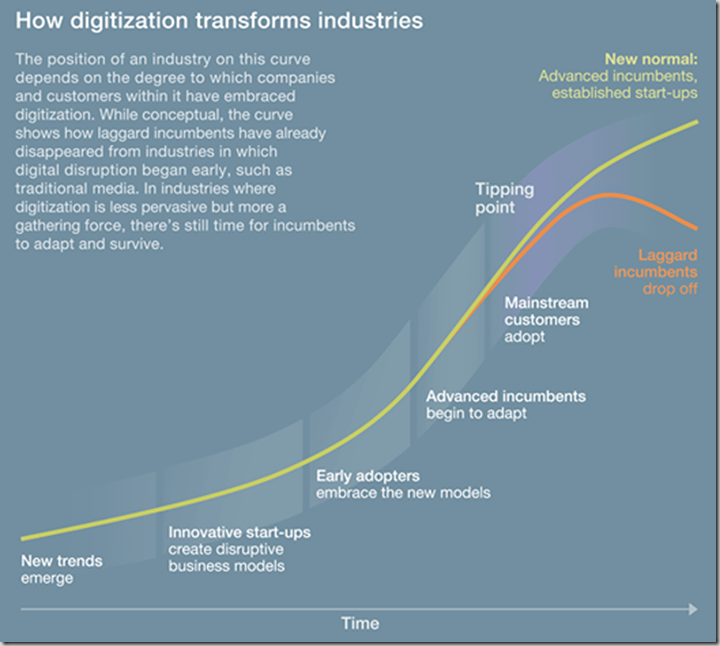
Digital capabilities increasingly will determine which companies create or lose value. Those shifts take place in the context of industry evolution, which isn’t monolithic but can follow a well-worn path: new trends emerge and disruptive entrants appear, their products and services embraced by early adopters (exhibit). Advanced incumbents then begin to adjust to these changes, accelerating the rate of customer adoption until the industry’s level of digitization—among companies but, perhaps more critically, among consumers as well—reaches a tipping point. Eventually, what was once radical is normal, and unprepared incumbents run the risk of becoming the next Blockbuster. Others, which have successfully built new capabilities (as Burberry did in retailing), become powerful digital players. (See the accompanying article, “The seven habits of highly effective digital enterprises.”) The opportunities for the leaders include:

  • Enhancing interactions among customers, suppliers, stakeholders, and employees. For many transactions, consumers and businesses increasingly prefer digital channels, which make content universally accessible by mixing media (graphics and video, for example), tailoring messages for context (providing location or demographic information), and adding social connectivity (allowing communities to build around themes and needs, as well as ideas shared among friends). These channels lower the cost of transactions and record them transparently, which can help in resolving disputes.
  • Improving management decisions as algorithms crunch big data from social technologies or the Internet of Things. Better decision making helps improve performance across business functions—for example, providing for finer marketing allocations (down to the level of individual consumers) or mitigating operational risks by sensing wear and tear on equipment.
  • Enabling new business or operating models, such as peer-to-peer product innovation or customer service. China’s Xiaomi crowdsources features of its new mobile phones rather than investing heavily in R&D, and Telstra crowdsources customer service, so that users support each other to resolve problems without charge. New business or operating models can also disintermediate existing customer–supplier relations—for example, when board-game developers or one-person shops manufacture products using 3-D printers and sell directly to Amazon.

The upshot is that digitization will change industry landscapes as it gives life to new sets of competitors. Some players may consider your capabilities a threat even before you have identified them as competitors. Indeed, the forces at work today will bring immediate challenges, opportunities—or both—to literally all digitally connected businesses.

Seven forces at work

Our research and experience with leading companies point to seven trends that could redefine competition.

1. New pressure on prices and margins

Digital technologies create near-perfect transparency, making it easy to compare prices, service levels, and product performance: consumers can switch among digital retailers, brands, and services with just a few clicks or finger swipes. This dynamic can commoditize products and services as consumers demand comparable features and simple interactions. Some banks, for instance, now find that simplifying products for easy purchase on mobile phones inadvertently contributes to a convergence between their offerings and those of competitors that are also pursuing mobile-friendly simplicity.

Third parties have jumped into this fray, disintermediating relationships between companies and their customers. The rise of price-comparison sites that aggregate information across vendors and allow consumers to compare prices and service offerings easily is a testament to this trend. In Europe, chain retailers, which traditionally dominate fast-moving consumer goods, have seen their revenues fall as customers flock to discounters after comparing prices even for staples like milk and bread. In South Korea, online aggregator OK Cashbag has inserted itself into the consumer’s shopping behavior through a mobile app that pools product promotions and loyalty points for easy use across more than 50,000 merchants.

These dynamics create downward pressure on returns across consumer-facing industries, and the disruptive currents are now rippling out to B2B businesses.

2. Competitors emerge from unexpected places

Digital dynamics often undermine barriers to entry and long-standing sources of product differentiation. Web-based service providers in telecommunications or insurance, for example, can now tap markets without having to build distribution networks of offices and local agents. They can compete effectively by mining data on risks and on the incomes and preferences of customers.

At the same time, the expense of building brands online and the degree of consumer attention focused on a relatively small number of brands are redrawing battle lines in many markets. Singapore Post is investing in an e-commerce business that benefits from the company’s logistics and warehousing backbone. Japanese web retailer Rakuten is using its network to offer financial services. Web powerhouses like Google and Twitter eagerly test industry boundaries through products such as Google Wallet and Twitter’s retail offerings.

New competitors can often be smaller companies that will never reach scale but still do a lot of damage to incumbents. In the retailing industry, for instance, entrepreneurs are cherry-picking subcategories of products and severely undercutting pricing on small volumes, forcing bigger companies to do the same.

3. Winner-takes-all dynamics

Digital businesses reduce transaction and labor costs, increase returns to scale from aggregated data, and enjoy increases in the quality of digital talent and intellectual property as network effects kick in. The cost advantages can be significant: online retailers may generate three times the level of revenue per employee as even the top-performing discounters. Comparative advantage can materialize rapidly in these information-intensive models—not over the multiyear spans most companies expect.

Scale economies in data and talent often are decisive. In insurance, digital “natives” with large stores of consumer information may navigate risks better than traditional insurers do. Successful start-ups known for digital expertise and engineer-friendly cultures become magnets for the best digital talent, creating a virtuous cycle. These effects will accelerate consolidation in the industries where digital scale weighs most heavily, challenging more capital- and labor-intensive models. In our experience, banking, insurance, media, telecommunications, and travel are particularly vulnerable to these winner-takes-all market dynamics.

In France, for instance, the start-up Free has begun offering mobile service supported by a large and active digital community of “brand fans” and advocates. The company nurtures opinion-leader “alpha fans,” who interact with the rest of the base on the Internet via blogs, social networks, and other channels, building a wave of buzz that quickly spreads across the digital world. Spending only modestly on traditional marketing, Free nonetheless has achieved high levels of customer satisfaction through its social-media efforts—and has gained substantial market share.2

4. Plug-and-play business models

As digital forces reduce transaction costs, value chains disaggregate. Third-party products and services—digital Lego blocks, in effect—can be quickly integrated into the gaps. Amazon, for instance, offers businesses logistics, online retail “storefronts,” and IT services. For many businesses, it may not pay to build out those functions at competitive levels of performance, so they simply plug an existing offering into their value chains. In the United States, registered investment advisers have been the fastest-growing segment3 of the investment-advisory business, for example. They are expanding so fast largely because they “insource” turnkey systems (including record keeping and operating infrastructure) purchased from Charles Schwab, Fidelity, and others that give them all the capabilities they need. With a license, individuals or small groups can be up and running their own firms.

In the travel industry, new portals are assembling entire trips: flights, hotels, and car rentals. The stand-alone offerings of third parties, sometimes from small companies or even individuals, plug into such portals. These packages are put together in real time, with dynamic pricing that depends on supply and demand. As more niche providers gain access to the new platforms, competition is intensifying.

5. Growing talent mismatches

Software replaces labor in digital businesses. We estimate, for instance, that of the 700 end-to-end processes in banks (opening an account or getting a car loan, for example), about half can be fully automated. Computers increasingly are performing complex tasks as well. “Brilliant machines,” like IBM’s Watson, are poised to take on the work of many call-center workers. Even knowledge-intensive areas, such as oncology diagnostics, are susceptible to challenge by machines: thanks to the ability to scan and store massive amounts of medical research and patients’ MRI results, Watson diagnoses cancers with much higher levels of speed and accuracy than skilled physicians do. Digitization will encroach on a growing number of knowledge roles within companies as they automate many frontline and middle-management jobs based upon synthesizing information for C-level executives.

At the same time, companies are struggling to find the right talent in areas that can’t be automated. Such areas include digital skills like those of artificial-intelligence programmers or data scientists and of people who lead digital strategies and think creatively about new business designs. A key challenge for senior managers will be sensitively reallocating the savings from automation to the talent needed to forge digital businesses. One global company, for example, is simultaneously planning to cut more than 10,000 employees (some through digital economies) while adding 3,000 to its digital business. Moves like these, writ large, could have significant social repercussions, elevating the opportunities and challenges associated with digital advances to a public-policy issue, not just a strategic-business one.

6. Converging global supply and demand

Digital technologies know no borders, and the customer’s demand for a unified experience is raising pressure on global companies to standardize offerings. In the B2C domain, for example, many US consumers are accustomed to e-shopping in the United Kingdom for new fashions (see sidebar, “How digitization is reshaping global flows”). They have come to expect payment systems that work across borders, global distribution, and a uniform customer experience.

Sidebar

How digitization is reshaping global flows

In B2B markets from banking to telecommunications, corporate purchasers are raising pressure on their suppliers to offer services that are standardized across borders, integrate with other offerings, and can be plugged into the purchasing companies’ global business processes easily. One global bank has aligned its offerings with the borderless strategies of its major customers by creating a single website, across 20 countries, that integrates what had been an array of separate national or product touch points. A US technology company has given each of its larger customers a customized global portal that allows it to get better insights into their requirements, while giving them an integrated view of global prices and the availability of components.

7. Relentlessly evolving business models—at higher velocity

Digitization isn’t a one-stop journey. A case in point is music, where the model has shifted from selling tapes and CDs (and then MP3s) to subscription models, like Spotify’s. In transportation, digitization (a combination of mobile apps, sensors in cars, and data in the cloud) has propagated a powerful nonownership model best exemplified by Zipcar, whose service members pay to use vehicles by the hour or day. Google’s ongoing tests of autonomous vehicles indicate even more radical possibilities to shift value. As the digital model expands, auto manufacturers will need to adapt to the swelling demand of car buyers for more automated, safer features. Related businesses, such as trucking and insurance, will be affected, too, as automation lowers the cost of transportation (driverless convoys) and “crash-less” cars rewrite the existing risk profiles of drivers.

Managing the strategic challenges: Six big decisions

Rethinking strategy in the face of these forces involves difficult decisions and trade-offs. Here are six of the thorniest.

Decision 1: Buy or sell businesses in your portfolio?

The growth and profitability of some businesses become less attractive in a digital world, and the capabilities needed to compete change as well. Consequently, the portfolio of businesses within a company may have to be altered if it is to achieve its desired financial profile or to assemble needed talent and systems.

Tesco has made a number of significant digital acquisitions over a two-year span to take on digital competition in consumer electronics. Beauty-product and fragrance retailer Sephora recently acquired Scentsa, a specialist in digital technologies that improve the in-store shopping experience. (Scentsa touch screens access product videos, link to databases on skin care and fragrance types, and make product recommendations.) Sephora officials said they bought the company to keep its technology out of competitors’ reach and to help develop in-store products more rapidly.4

Companies that lack sufficient scale or expect a significant digital downside should consider divesting businesses. Some insurers, for instance, may find themselves outmatched by digital players that can fine-tune risks. In media, DMGT doubled down on an investment in their digital consumer businesses, while making tough structural decisions on their legacy print assets, including the divestment of local publications and increases in their national cover price. Home Depot continues to shift its investment strategy away from new stores to massive new warehouses that serve growing online sales. This year it bought Blinds.com, adding to a string of website acquisitions.5

Decision 2: Lead your customers or follow them?

Incumbents too have opportunities for launching disruptive strategies. One European real-estate brokerage group, with a large, exclusively controlled share of the listings market, decided to act before digital rivals moved into its space. It set up a web-based platform open to all brokers (many of them competitors) and has now become the leading national marketplace, with a growing share. In other situations, the right decision may be to forego digital moves—particularly in industries with high barriers to entry, regulatory complexities, and patents that protect profit streams.

Between these extremes lies the all-too-common reality that digital efforts risk cannibalizing products and services and could erode margins. Yet inaction is equally risky. In-house data on existing buyers can help incumbents with large customer bases develop insights (for example, in pricing and channel management) that are keener than those of small attackers. Brand advantages too can help traditional players outflank digital newbies.

Decision 3: Cooperate or compete with new attackers?

A large incumbent in an industry that’s undergoing digital disruption can feel like a whale attacked by piranhas. While in the past, there may have been one or two new entrants entering your space, there may be dozens now—each causing pain, with none individually fatal. PayPal, for example, is taking slices of payment businesses, and Amazon is eating into small-business lending. Companies can neutralize attacks by rapidly building copycat propositions or even acquiring attackers. However, it’s not feasible to defend all fronts simultaneously, so cooperation with some attackers can make more sense than competing.

Santander, for instance, recently went into partnership with start-up Funding Circle. The bank recognized that a segment of its customer base wanted access to peer-to-peer lending and in effect acknowledged that it would be costly to build a world-class offering from scratch. A group of UK banks formed a consortium to build a mobile-payment utility (Paym) to defend against technology companies entering their markets. British high-end grocer Waitrose collaborated with start-up Ocado to establish a digital channel and home distribution before eventually creating its own digital offering.

Digital technologies themselves are opening pathways to collaborative forms of innovation. Capital One launched Capital One Labs, opening its software interfaces to multiple third parties, which can defend a range of spaces along their value chains by accessing Capital One’s risk- and credit-assessment capabilities without expending their own capital.

Decision 4: Diversify or double down on digital initiatives?

As digital opportunities and challenges proliferate, deciding where to place new bets is a growing headache for leaders. Diversification reduces risks, so many companies are tempted to let a thousand flowers bloom. But often these small initiatives, however innovative, don’t get enough funding to endure or are easily replicated by competitors. One answer is to think like a private-equity fund, seeding multiple initiatives but being disciplined enough to kill off those that don’t quickly gain momentum and to bankroll those with genuinely disruptive potential. Since 2010, Merck’s Global Health Innovation Fund, with $500 million under management, has invested in more than 20 start-ups with positions in health informatics, personalized medicine, and other areas—and it continues to search for new prospects. Other companies, such as BMW and Deutsche Telekom, have set up units to finance digital start-ups.

The alternative is to double down in one area, which may be the right strategy in industries with massive value at stake. A European bank refocused its digital investments on 12 customer decision journeys,6 such as buying a house, that account for less than 5 percent of its processes but nearly half of its cost base. A leading global pharmaceutical company has made significant investments in digital initiatives, pooling data with health insurers to improve rates of adherence to drug regimes. It is also using data to identify the right patients for clinical trials and thus to develop drugs more quickly, while investing in programs that encourage patients to use monitors and wearable devices to track treatment outcomes. Nordstrom has invested heavily to give its customers multichannel experiences. It focused initially on developing first-class shipping and inventory-management facilities and then extended its investments to mobile-shopping apps, kiosks, and capabilities for managing customer relationships across channels.

Decision 5: Keep digital businesses separate or integrate them with current nondigital ones?

Integrating digital operations directly into physical businesses can create additional value—for example, by providing multichannel capabilities for customers or by helping companies share infrastructure, such as supply-chain networks. However, it can be hard to attract and retain digital talent in a traditional culture, and turf wars between the leaders of the digital and the main business are commonplace. Moreover, different businesses may have clashing views on, say, how to design and implement a multichannel strategy.

One global bank addressed such tensions by creating a groupwide center of excellence populated by digital specialists who advise business units and help them build tools. The digital teams will be integrated with the units eventually, but not until the teams reach critical mass and notch a number of successes. The UK department-store chain John Lewis bought additional digital capabilities with its acquisition of the UK division of Buy.com,7 in 2001, ultimately combining it with the core business. Wal-Mart Stores established its digital business away from corporate headquarters to allow a new culture and new skills to grow. Hybrid approaches involving both stand-alone and well-integrated digital organizations are possible, of course, for companies with diverse business portfolios.

Decision 6: Delegate or own the digital agenda?

Advancing the digital agenda takes lots of senior-management time and attention. Customer behavior and competitive situations are evolving quickly, and an effective digital strategy calls for extensive cross-functional orchestration that may require CEO involvement. One global company, for example, attempted to digitize its processes to compete with a new entrant. The R&D function responsible for product design had little knowledge of how to create offerings that could be distributed effectively over digital channels. Meanwhile, a business unit under pricing pressure was leaning heavily on functional specialists for an outsize investment to redesign the back office. Eventually, the CEO stepped in and ordered a new approach, which organized the digitization effort around the decision journeys of clients.

Faced with the need to sort through functional and regional issues related to digitization, some companies are creating a new role: chief digital officer (or the equivalent), a common way to introduce outside talent with a digital mind-set to provide a focus for the digital agenda. Walgreens, a well-performing US pharmacy and retail chain, hired its president of digital and chief marketing officer (who reports directly to the CEO) from a top technology company six years ago. Her efforts have included leading the acquisition of drugstore.com, which still operates as a pure play. The acquisition upped Walgreens’ skill set, and drugstore.com increasingly shares its digital infrastructure with the company’s existing site: walgreens.com.

Relying on chief digital officers to drive the digital agenda carries some risk of balkanization. Some of them, lacking a CEO’s strategic breadth and depth, may sacrifice the big picture for a narrower focus—say, on marketing or social media. Others may serve as divisional heads, taking full P&L responsibility for businesses that have embarked on robust digital strategies but lacking the influence or authority to get support for execution from the functional units.

Alternatively, CEOs can choose to “own” and direct the digital agenda personally, top down. That may be necessary if digitization is a top-three agenda item for a company or group, if digital businesses need substantial resources from the organization as a whole, or if pursuing new digital priorities requires navigating political minefields in business units or functions.

Regardless of the organizational or leadership model a CEO and board choose, it’s important to keep in mind that digitization is a moving target. The emergent nature of digital forces means that harnessing them is a journey, not a destination—a relentless leadership experience and a rare opportunity to reposition companies for a new era of competition and growth.

About the authors

Martin Hirt is a director in McKinsey’s Taipei office, and Paul Willmott is a director in the London office.

The authors would like to acknowledge the contributions of ’Tunde Olanrewaju and Meng Wei Tan to this article.

POST GRADUATE EXECUTIVE PROGRAMME IN FINANCIAL MARKETS

National Institute of Financial Management

NSE


POST GRADUATE EXECUTIVE PROGRAMME IN

FINANCIAL MARKETS

1 YEAR, WEEKEND PROGRAMME 2014-15

Jointly Offered by

NATIONAL INSTITUTE OF FINANCIAL MANAGEMENT

(Ministry of Finance, Government of India) and

NATIONAL STOCK EXCHANGE OF INDIA LIMITED

Dear Candidate

NSE in partnership with National Institute of Financial Management (NIFM), Faridabad (Ministry of Finance, Govt. of India), is offering 1 year Post Graduate Executive Programme in Financial Markets for the academic year 2014-15. PGEP-FM is aweekend programme to be held from 25th August'14 at Delhi.

The highlights of the programme are:

Certified jointly by NIFM and NSE

Multiple career options in banks, FIIs, DIIs, AMCs, broking etc.

Global exposure - Visit to International Stock Exchange

Comprehensive market coverage spanning 20 papers

Simulated live market trading from NSE

Faculty - Industry experts & academicians

Industry relevant professional skills

Experiential learning - Workshops, industry visits

Eligibility
Last date

Graduation and 2 years of experience.
The last date for submitting application is 18th August 2014.

Contact :

Apply now

Mr. Saurabh - 9582230057 / 011-49393057

Ms. Garima - 9718930064 / 49393062

Email to : pgepfm@nse.co.in